Dubai or Doha: Which Stopover Hub Works Best for Your Safari Route?
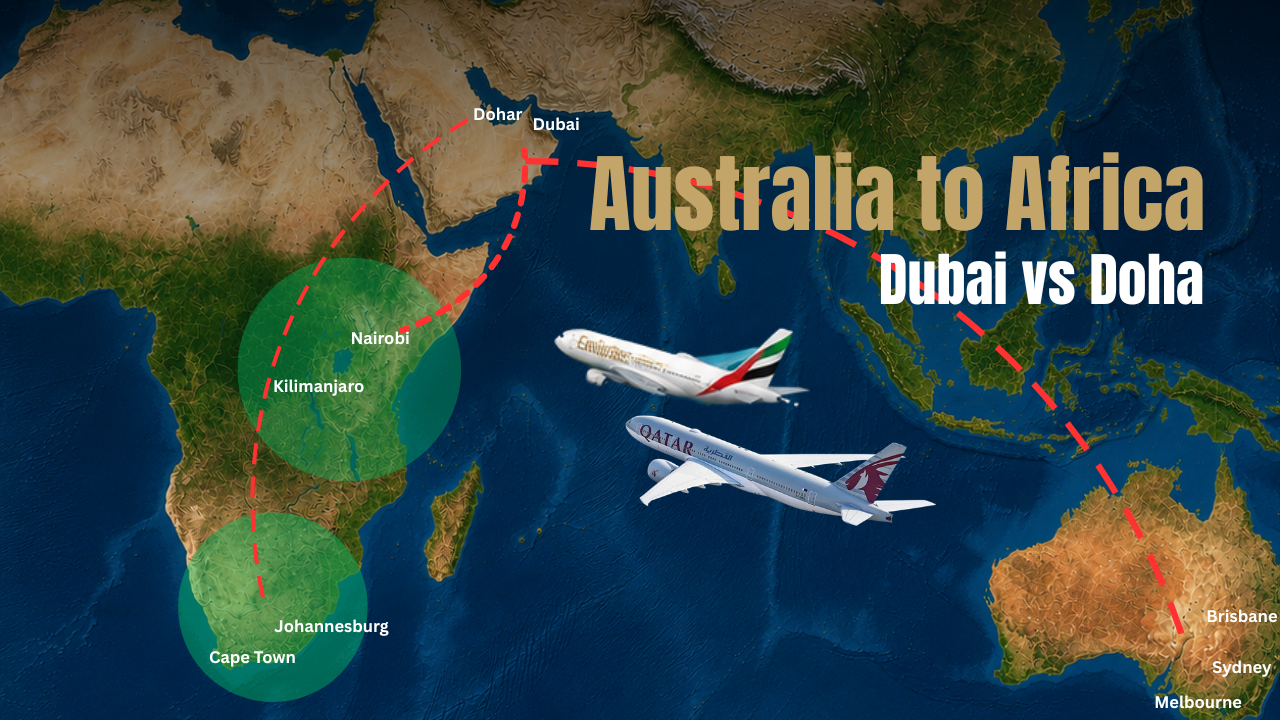
In our guide to flying from Australia to Africa for safari, we outlined the main routing options available to Australian travellers. For anyone heading to East Africa or combining East and Southern Africa in a single itinerary, the one-stop hub through the Middle East is typically the most practical choice. That raises an immediate question: Dubai or Doha?
Both cities sit almost exactly halfway between Australia and Africa. World-class airlines from every Australian capital serve them. Each offers excellent onward connections to multiple African destinations. Yet they differ in meaningful ways, and for a safari itinerary, the differences matter.
The Case for Dubai and Emirates
Emirates operates from Sydney, Melbourne, Brisbane, Perth, and Adelaide to Dubai’s Dubai International Airport (DXB), with multiple daily departures from the larger cities. From Dubai, the airline serves Nairobi, Johannesburg, Cape Town, Kilimanjaro, and a growing list of secondary African cities.
The frequency to Nairobi is exceptional. From March 2026, Emirates will run three daily services between Dubai and Nairobi, 21 flights per week, giving Australian travellers arriving at almost any time from any city a well-timed onward connection. This matters because Nairobi is the gateway to the Maasai Mara, Amboseli, Samburu, and the northern Tanzanian circuit. More frequency means you can engineer your arrival to maximise rest before your first flight into the bush.
Emirates also has an interline partnership with Kenya Airways, which feeds passengers from Nairobi into dozens of regional East African destinations, including Mombasa, Zanzibar, Kilimanjaro, and Entebbe in Uganda. When this partnership works well, it means a single booking can carry you from Sydney all the way to a remote airstrip.
The Emirates A380 product on the Australia–Dubai leg is one of the best-known long-haul experiences in commercial aviation. Business Class cabins feature enclosed suites on the upper deck, a full bar and social space, and generous flat beds. The First Class cabin, available on A380 services, includes a private suite, onboard shower, and one of the most refined in-flight service cultures in the industry. For a flight of 13 to 14 hours from Australia, this is worth serious consideration.
Dubai Airport itself can be congested at peak times. Transfer experience varies depending on the time of day and how efficiently your inbound flight connects. Emirates Business and First Class passengers have access to dedicated lounges that make a two- to four-hour layover comfortable rather than exhausting.
The Case for Doha and Qatar Airways
Qatar Airways departs from Sydney, Melbourne, Brisbane, Perth, and Adelaide into Doha’s Hamad International Airport (DOH). Onward connections reach Nairobi, Johannesburg, Cape Town, Dar es Salaam, and Kilimanjaro.
Qatar offers daily nonstop service between Doha and Johannesburg, a flight of approximately nine hours, which means the Doha hub works as well for southern Africa as it does for East Africa. For travellers on multi-country safaris that combine, say, the Maasai Mara and the Okavango Delta, routing in through Nairobi and out through Johannesburg is entirely achievable on a Qatar Airways itinerary.

Qatar Airways and Kenya Airways
A memorandum of understanding signed in July 2025 between Qatar Airways and Kenya Airways is expected to produce a third daily Doha–Nairobi service under a codeshare arrangement, increasing the frequency parity between the two Gulf hubs.
The quality of the Qatar Airways product is exceptional. Qsuite, available on many Australia–Doha and Doha–Africa sectors, is the most privacy-focused Business Class product in commercial aviation. Each suite has a sliding door, a screen that separates the occupant from the aisle, and a bed that extends to 203 centimetres. Paired suites can be configured as a double, which makes the product particularly suited to couples travelling together. For a journey that may involve 20-plus hours of flying, arriving in Africa in a Qsuite is a different experience to arriving in a conventional cabin.
Hamad International Airport consistently ranks at or near the top of global airport quality assessments. The terminal is spacious, well-designed, and easy to navigate. Qatar Airways Platinum and Gold members, along with oneworld Emerald and Sapphire passengers, access the dedicated Al Mourjan lounge. Standard Business Class travellers have access to the Al Mourjan Business Lounge, which travel industry surveys consistently rank among the finest airport lounges in the world.
Baggage allowances on Qatar are notably generous by international standards: 30 kilograms in Economy, 40 kilograms in Business, and 50 kilograms in First Class. This matters for the outbound international leg, though the limits imposed by African light aircraft (see our luggage guide) apply regardless once you’re in the bush.
Schedule Alignment: Which Hub Puts You in Africa at the Right Time?
This is the practical test, and it depends on your safari entry point.
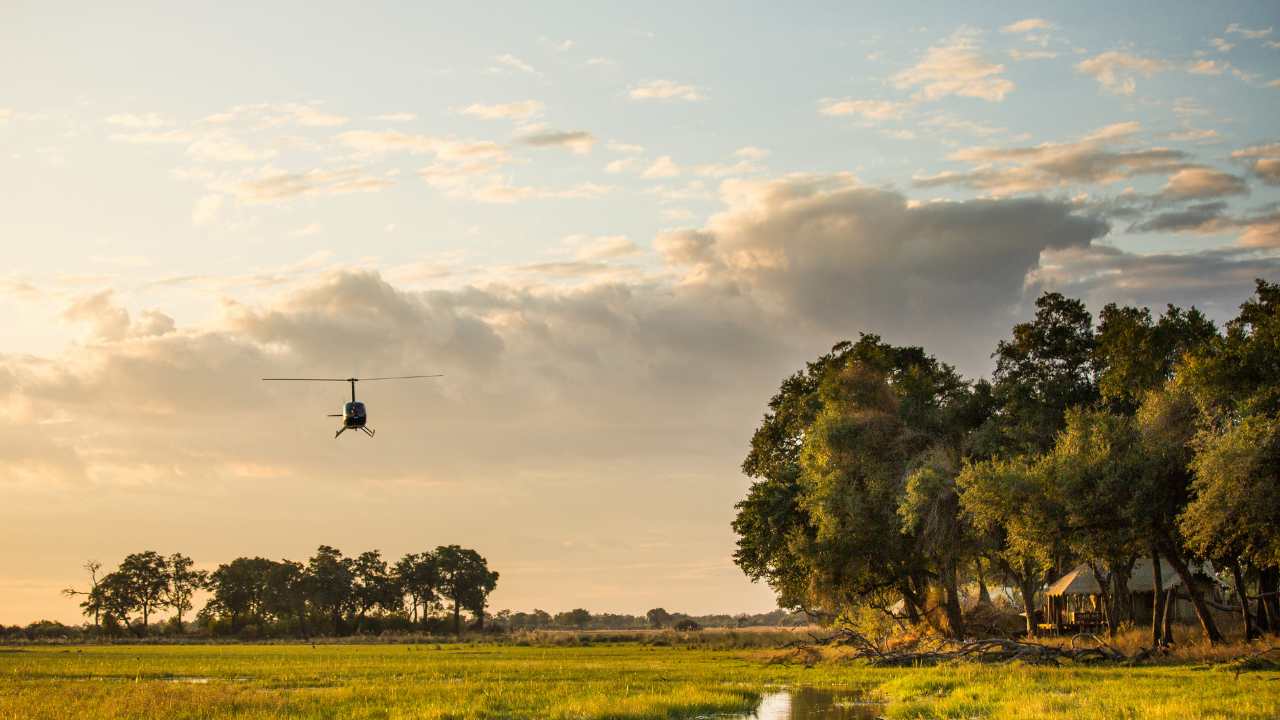
For Nairobi: Emirates’ three daily departures from Dubai give more schedule options than most competing connections. A mid-morning arrival in Nairobi works well — it leaves enough time to transfer to Wilson Airport for a late-afternoon bush flight into the Maasai Mara, arriving in time for a sundowner and the following morning’s game drive. Qatar’s additional Nairobi frequencies, expected from the Kenya Airways codeshare, will narrow this gap.
For Johannesburg: Qatar Airways’ nonstop Doha–Johannesburg timing tends to deliver a morning arrival at OR Tambo, which aligns well with onward connections to Kruger (Hoedspruit or Skukuza), the Okavango Delta (Maun), or Victoria Falls (Livingstone). Emirates achieves similar results on its Johannesburg service, which also runs daily.
For Kilimanjaro (Tanzania northern circuit): Both hubs serve Kilimanjaro via connections in Nairobi or on direct services. Check schedules at the time of booking, as frequency on the Doha–Kilimanjaro and Dubai–Kilimanjaro routes is lower than on the main hub connections.
Connecting Back Out of Africa
The return itinerary is where Doha sometimes holds an edge for multi-destination safaris. If you end your trip in a different country from where you entered, a common scenario, Qatar’s hub handles the routing cleanly. An itinerary that starts in Nairobi, moves through Tanzania, and exits via Johannesburg often fits neatly onto a single Qatar ticket or with a relatively simple connection.
Emirates performs similarly for multi-country routing, particularly with the Kenya Airways interline covering East African connections and the Airlink codeshare connecting southern African cities through Johannesburg.
Which Hub Should You Choose?
East Africa-focused safaris give Emirates and Dubai a slight frequency advantage in Nairobi. That third daily service makes schedule alignment easier. Travellers who prioritise the onboard cabin experience above all else will find Qatar Airways and Qsuite in Business Class set the benchmark.
Southern Africa safaris, with Johannesburg as the hub, suit both carriers well. Multi-destination safaris that cross from East into Southern Africa, or vice versa, suit the Qatar routing slightly better due to the clean Doha–Johannesburg connection.
The honest answer is that either hub will get you to Africa comfortably. It’s important to make sure the connection is correctly timed. What matters most is choosing an itinerary that aligns with the arrival schedule, with your first safari activity. Don’t let this be wasted by the price of the fare.
For luggage considerations once you’re in Africa. Why your international allowance becomes almost irrelevant from the moment you board a bush plane, read our guide: Safari Luggage Rules: What Australian Travellers Get Wrong
If you’re deciding between Nairobi and Kilimanjaro as your East Africa entry point, that question has its own answer: Flying into East Africa: Nairobi vs Kilimanjaro for Safari
Talk to African Signature Journeys
Choosing between hubs is rarely the hard part. Aligning a hub routing with a two- or three-country safari, your business class preferences, and your Frequent Flyer points balance is where experience matters. African Signature Journeys plans the full journey, not just the safari end of it.
NOTE- Flights and Schedules change regularly. This is to give you an idea of what is possible. Please consult with one of our African Specialists to get the most up-to-date information
Also in This Series
- Pillar: Australia to Africa Safari Flights: Complete Route Guide
- Hub 1: Dubai or Doha: Which Hub Works Best for Your Safari Route? (You are here)
- Hub 2: Flying into East Africa: Nairobi vs Kilimanjaro for Safari
- Hub 3: Safari Luggage Rules: What Australian Travellers Get Wrong

Sean Lues
Award Winning Safari Guide
Content by Award Winning Safari Guides
The content on African Signature Journeys is overseen by Sean Lues, an award-winning professional safari guide who was born and raised in Zimbabwe and has spent decades living, guiding, and managing safari operations across Africa.
Winner of the Zimbabwe Professional Guides Association Guide of the Year award, Sean is recognised for his deep knowledge of African wildlife, landscapes, and safari experiences. Now based in Australia, he combines firsthand African expertise with an understanding of what Australian travellers want from their safari adventure.
His experience helps ensure the information, recommendations, and insights shared by African Signature Journeys are practical, accurate, and based on real-world experience.