Flying from Australia to Africa for Safari: What You Need to Know
The distance between Australia and Africa is one of the longest in world travel. Done well, the journey is part of the adventure. Done badly, you arrive exhausted and lose your first game drive to jet lag. Knowing the routes, the hubs, and the quirks of African Safari Flights aviation makes all the difference.
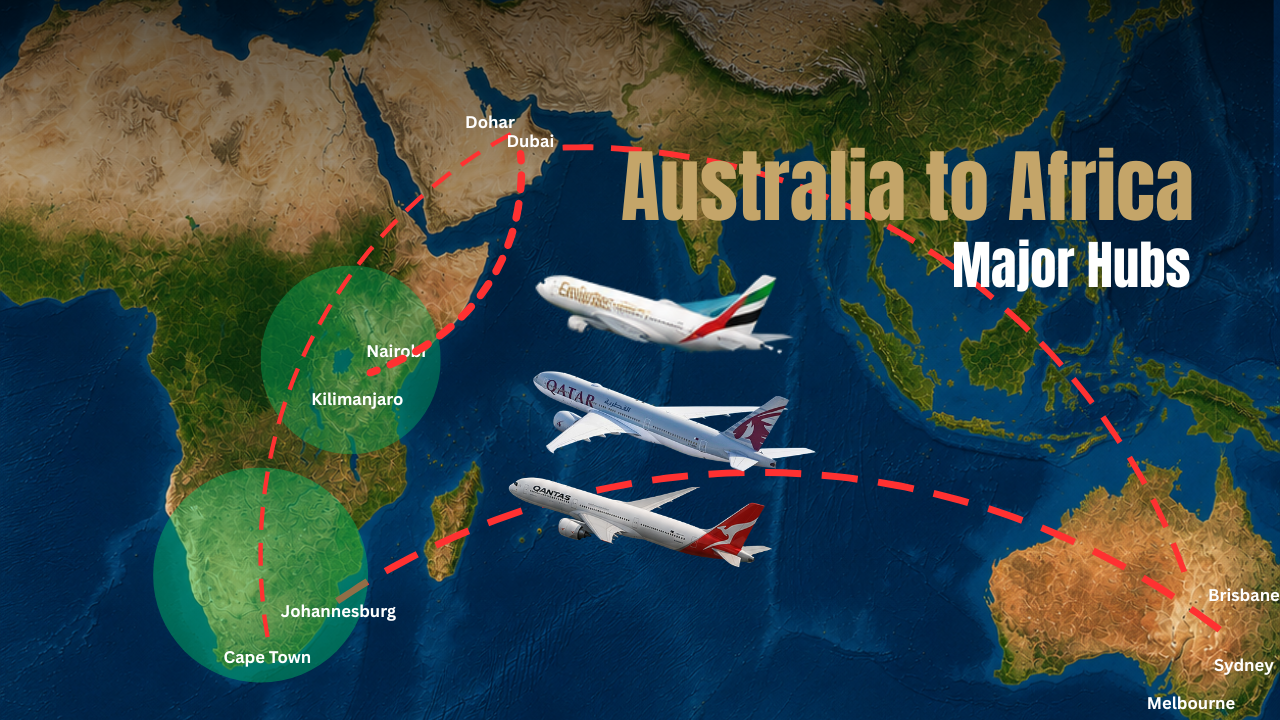
This guide covers most meaningful Safari Flight options available for Australian travellers, from the nonstop Qantas flight out of Sydney to the one-stop connections through Dubai, Doha, and Singapore, and how each route lines up with where you actually want to go on safari.
The Direct Option: Qantas Sydney to Johannesburg
The simplest route for East Coast Australians is the Qantas nonstop service between Sydney and Johannesburg. It operates on an Airbus A380 up to six times per week, with a flight time of 14 hours and 40 minutes westbound. The return leg, carried by the tailwinds, takes just 11 hours and 55 minutes, making it one of the most asymmetric long-haul routes in commercial aviation.
This is the world’s only A380 service that crosses the southern Indian Ocean. On the southerly routing, on a clear day, passengers can sometimes see Antarctica from the window.
The A380 configuration gives Australian safari travellers genuine options for great Safari Flights. Across the four cabins, it carries 14 First Class suites in a 1-1-1 layout with 212-centimetre flat beds, 70 Business Class seats with access to the upper-deck lounge, 60 Premium Economy seats, and 341 Economy seats. First Class returned to the Sydney–Johannesburg route with the A380 upgrade in 2024, the first time it had been available since 2018.
Perth travellers have a separate, more convenient option. Qantas launched a direct Perth to Johannesburg service in December 2025, operating three times per week with an Airbus A330-200. The flight time is approximately 11 hours and 15 minutes, making it the shortest Australia–Africa routing by a considerable margin.
Johannesburg’s OR Tambo International Airport is the natural gateway into southern Africa. From there, it’s a short domestic safari flight or drive to Kruger National Park, the Sabi Sand Game Reserve, and regional hubs for Botswana, Zimbabwe, Zambia, and Namibia.
One-Stop Routes: The Middle Eastern Hubs
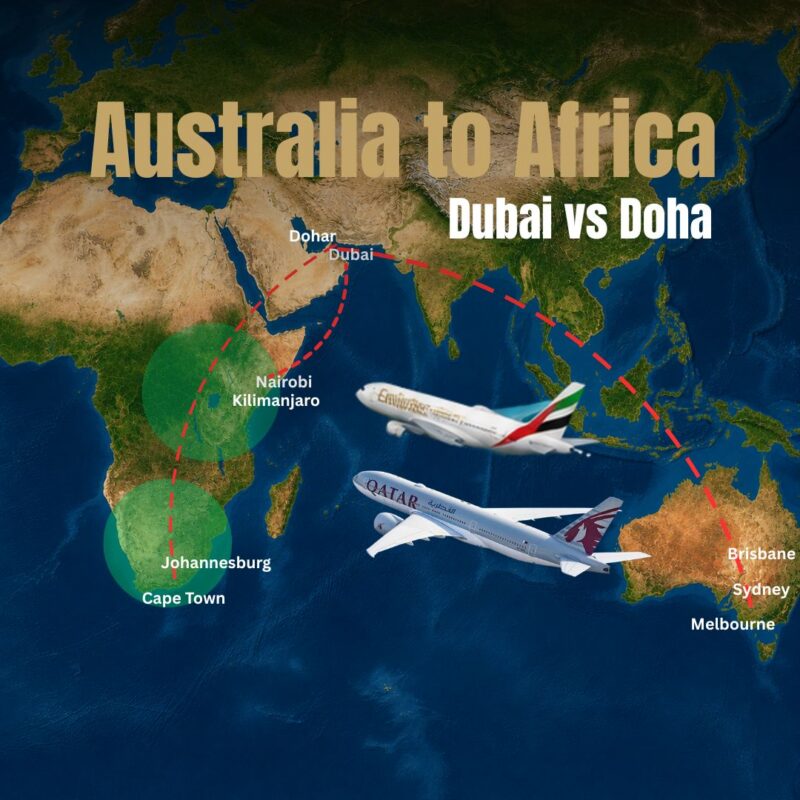
For travellers heading to East Africa — Kenya, Tanzania, Rwanda, the direct Sydney–Johannesburg flight is not always the most logical choice. A one-stop connection via Dubai or Doha often produces a shorter overall travel time and far more convenient onward connections into Nairobi or Kilimanjaro.
Emirates via Dubai is the most popular single-stop routing for Australian safari travellers. Emirates operates multiple daily flights from Sydney, Melbourne, Brisbane, Perth, and Adelaide to Dubai. From Dubai, onward services run to Nairobi, Johannesburg, Cape Town, and Kilimanjaro. Emirates added a third daily Dubai–Nairobi service from March 2026, giving Australian travellers exceptional schedule flexibility into East Africa’s most important safari gateway.
Qatar Airways via Doha is Emirates’ closest rival on quality and coverage. Qatar flies from Sydney, Melbourne, Brisbane, Perth, and Adelaide into Hamad International Airport, which consistently ranks among the world’s best-connected hubs. Onward connections reach Nairobi, Johannesburg, Cape Town, and Dar es Salaam. For travellers on multi-destination safaris combining East and Southern Africa, Doha connections are particularly well timed. Qatar’s Qsuite Business Class has earned a reputation as the finest long-haul product in the sky.
For a deep dive into which Middle Eastern hub suits your safari destination best, read our dedicated guide: Dubai or Doha: Which Hub Works Best for Your Safari Route?
East Africa Entry Points: Nairobi vs Kilimanjaro
If Kenya or Tanzania is the destination, the gateway airport matters as much as the airline.
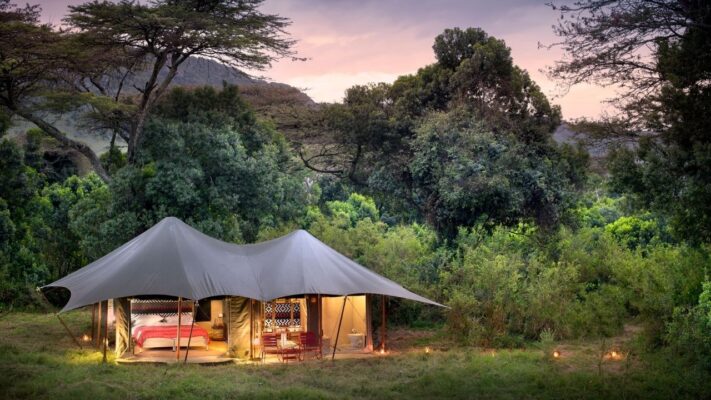
Nairobi’s Jomo Kenyatta International Airport is the main hub for East Africa. It connects easily to the Maasai Mara via Wilson Airport for light aircraft charters, to Amboseli, and to onward services into northern Tanzania, including Kilimanjaro and Dar es Salaam. Kenya Airways, in partnership with Emirates, links Nairobi to dozens of regional destinations.
Kilimanjaro International Airport serves Tanzania’s northern circuit directly, the Serengeti, Ngorongoro Crater, Tarangire, and Lake Manyara. If your entire itinerary is in Tanzania, flying into Kilimanjaro avoids the extra connection through Nairobi entirely.
We’ve written a full breakdown of how to enter East Africa for safari: Flying into East Africa: Nairobi vs Kilimanjaro for Safari
Southern Africa Entry Points: Johannesburg and Beyond
Johannesburg is the air hub of southern Africa. Almost every regional safari flight connection to Botswana, Zambia, Zimbabwe, Namibia, and Cape Town flows through OR Tambo International Airport. The airport operates efficiently for transit passengers and has reasonably good lounges for Business and First Class travellers.
From Johannesburg, the options branch widely:
- A 45-minute South African Airlink flight drops you into Hoedspruit or Skukuza for Kruger and the Sabi Sand
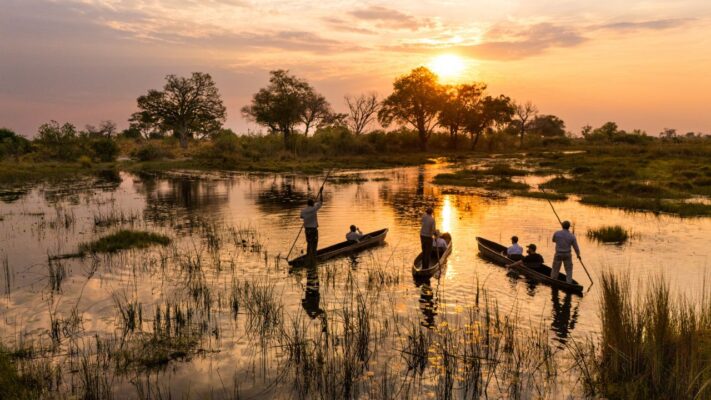
- A 2.5-hour flight reaches Maun for the Okavango Delta in Botswana
- A 2-hour flight lands in Livingstone, adjacent to Victoria Falls
- A 1.5-hour flight connects to Windhoek for Namibia’s Etosha and the Namib Desert
Qantas has a codeshare with Airlink, which simplifies regional connections and allows checked luggage to flow through on a single ticket in many cases.
The Luggage Problem Every Australian Needs to Understand
Here is where most first-time Australian safari travellers get caught off guard.
Your international flight, whether Qantas nonstop or Emirates via Dubai, allows 23 to 30 kilograms of checked baggage in Economy, more in Business. Once you reach Africa and board a light aircraft to a remote camp, the rules change completely.
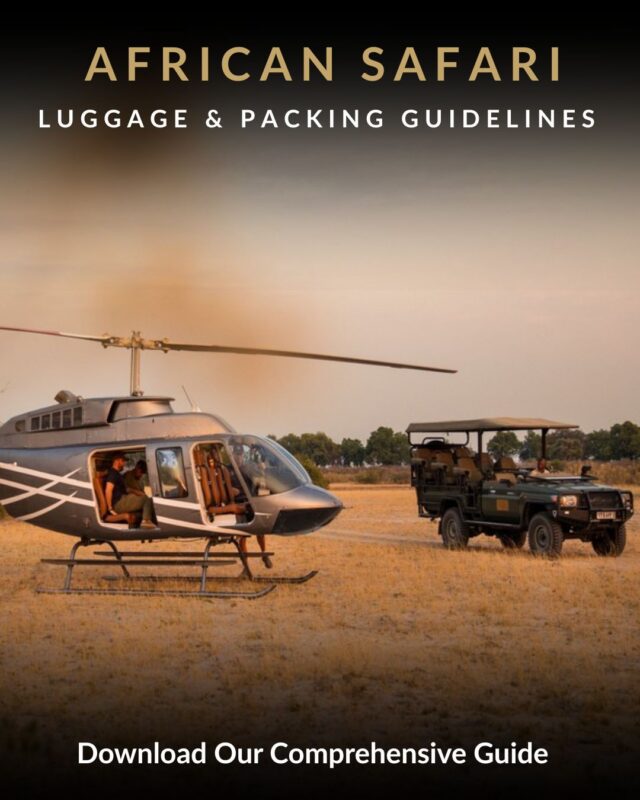
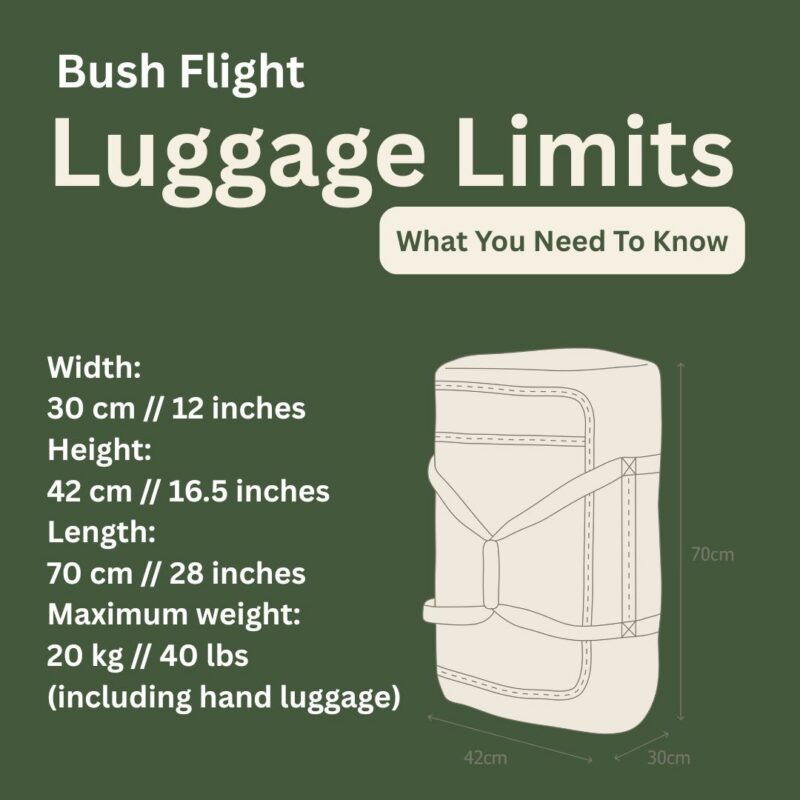
Bush planes, Cessna Caravans, Pilatus Porters, and similar light aircraft operate on short grass airstrips at high altitude in tropical heat. Weight directly affects safety. Most operators in East Africa enforce a combined luggage limit of 15 kilograms per person, including hand luggage. Southern African operators tend to allow 20 kilograms. The bags must be soft-sided, duffel bags without rigid frames or wheels. A hard-shell suitcase simply cannot be loaded into the cargo pod of a bush plane.
This is not a suggestion. Pilots have authority to refuse oversized or overweight luggage at the airstrip, with no alternative available for kilometres in any direction.
The practical solution is to pack for safari within these limits from the outset. Soft duffel bags of 40–45 litres, combined with a small daypack, fit the constraints of both international and bush flights. Most camps provide daily laundry, so there is genuinely no need to pack for every day of the journey.
For a complete guide to packing within African aviation limits, see: Safari Luggage Rules: What Australian Travellers Get Wrong
How to Choose the Right Route For Your Safari Flight
The best flight routing depends on where your safari takes you, not just what’s cheapest or most convenient from your home city.
Sydney or Melbourne to East Africa (Maasai Mara, Serengeti, Ngorongoro, Zanzibar): A one-stop via Dubai or Doha into Nairobi is typically faster and more direct than flying to Johannesburg first. Total travel time runs 20–24 hours.
Sydney to Southern Africa (Kruger, Sabi Sand, Botswana, Victoria Falls): The Qantas nonstop to Johannesburg is hard to beat for simplicity. You arrive with one flight behind you and a short connection ahead.
Perth to anywhere in Africa: The Qantas Perth–Johannesburg nonstop is the most efficient option for Western Australians, just over 11 hours to a hub with connections everywhere. One-stop Gulf carrier options via Dubai are the alternative.
Multi-country itineraries (East and Southern Africa combined): A one-stop hub through Dubai or Doha gives the most flexibility to enter in Nairobi and exit via Johannesburg, or vice versa, on a single itinerary.
What to Book in Business Class
The Sydney–Johannesburg flight runs almost 15 hours against the prevailing winds. The Dubai and Doha connections add a short hub layover to total journeys of 20–24 hours. For a safari holiday of this significance and cost, the argument for upgrading to Business Class is strong.
Qantas Business Class on the A380 features the Suites product in the upper-deck cabin, with direct-aisle access and lie-flat beds. The upper-deck lounge, exclusive to Business and First passengers, is a genuine amenity on a 14-plus hour flight. For couples, Qatar Airways’ Qsuite offers enclosed privacy suites that convert to double beds — unmatched on any long-haul route. On the Emirates A380, a full bar and social lounge on the upper deck sets the tone for the Australia–Dubai leg. For any of these routes, the case for upgrading strengthens considerably once you factor in the total travel time.
A Note on Timing Your Arrival
Jet lag matters on safari. Game drives begin before dawn, typically 5:30 to 6:00 am, and your guide will not wait if you are still adjusting. Arriving a day before your first game drive is sound planning, not indulgence.
Most Qantas nonstop flights depart Sydney in the late afternoon and arrive in Johannesburg the following morning, which works well. Gulf carrier connections into Nairobi often arrive early morning, giving you a full day to rest before your first bush flight. Build that buffer into the itinerary.
Plan Your Route with African Signature Journeys
Getting from Australia to Africa efficiently is something we help with as part of every itinerary we design. The flight routing is part of the journey, and aligning it with your safari destinations, your travel class preferences, and your Frequent Flyer strategy is something our team thinks about carefully.
Contact African Signature Journeys to start planning your safari. We’ll make sure the journey begins and ends in the right way.
NOTE- Flights and Schedules change regularly. This is to give you an idea of what is possible. Please consult with one of our African Specialists to get the most up-to-date information
Also in This Series
- Pillar: Australia to Africa Safari Flights: Complete Route Guide (You are here)
- Hub 1: Dubai or Doha: Which Hub Works Best for Your Safari Route?
- Hub 2: Flying into East Africa: Nairobi vs Kilimanjaro for Safari
- Hub 3: Safari Luggage Rules: What Australian Travellers Get Wrong

Sean Lues
Award Winning Safari Guide
Content by Award Winning Safari Guides
The content on African Signature Journeys is overseen by Sean Lues, an award-winning professional safari guide who was born and raised in Zimbabwe and has spent decades living, guiding, and managing safari operations across Africa.
Winner of the Zimbabwe Professional Guides Association Guide of the Year award, Sean is recognised for his deep knowledge of African wildlife, landscapes, and safari experiences. Now based in Australia, he combines firsthand African expertise with an understanding of what Australian travellers want from their safari adventure.
His experience helps ensure the information, recommendations, and insights shared by African Signature Journeys are practical, accurate, and based on real-world experience.